

TL;DR:
- WHOIS reveals domain registration details but increasingly includes redacted or privacy-protected data.
- It is a useful tool for domain management, troubleshooting, and abuse reporting but is not foolproof.
- Future shifts to RDAP introduce structured data and privacy controls, requiring layered investigative approaches.
Most people assume their online presence is either fully exposed or safely hidden. Neither is true. The reality sits somewhere in between, and WHOIS lookup is one of the clearest illustrations of this tension. As a protocol for querying databases that store registration data for domain names, IP address blocks, and autonomous system numbers, WHOIS surfaces details like registrant contact information, registrar identity, registration dates, and nameservers. For website administrators, online marketers, and privacy-conscious users, understanding how WHOIS works and what it can and cannot reveal is not optional. It is foundational to managing digital assets responsibly.
Table of Contents
- What is a WHOIS lookup and how does it work?
- Key uses of WHOIS lookup for website administrators
- Why WHOIS matters to online marketers and privacy-focused users
- Limits, privacy controls, and the future: WHOIS, RDAP, and redaction
- The uncomfortable truth: WHOIS lookup is not a silver bullet for online security
- Explore advanced lookup tools for deeper insight
- Frequently asked questions
Key Takeaways
| Point | Details |
|---|---|
| WHOIS exposes essential domain data | Information like owner, registrar, and expiry are central to security and management. |
| RDAP is the new standard | RDAP replaces WHOIS for greater privacy, reliability, and structured access in 2026. |
| Privacy is now prioritised | Most personal data is masked under GDPR and privacy proxy regulations. |
| One tool in a layered defence | WHOIS must be used alongside other tools for effective online security or privacy. |
What is a WHOIS lookup and how does it work?
At its core, WHOIS is a query-and-response protocol. When you submit a query, it travels via TCP port 43 to an authoritative WHOIS server, which is determined by the top-level domain or regional internet registry involved. The server returns a human-readable text response containing registration details. Simple in concept, but the underlying architecture is more layered than it first appears.
There are two distinct registry models worth knowing:
- Thick registry model: The registry itself stores the full registration record, including registrant name, contact details, and nameserver data. This makes querying straightforward because all data lives in one place.
- Thin registry model: The registry holds only minimal data, such as the registrar’s identity, and points queries to the registrar’s own WHOIS server for the full record. This adds an extra step and can create inconsistencies.
The table below summarises the key differences:
| Feature | Thick model | Thin model |
|---|---|---|
| Data location | Centralised at registry | Distributed at registrar |
| Query steps | Single query | Two queries |
| Consistency | Higher | Lower |
| Example TLDs | .org, .info | Historically .com, .net |
A significant shift is now well underway. RDAP, the Registration Data Access Protocol, is the modern successor to WHOIS, mandated by ICANN for generic top-level domains since January 2025. Unlike WHOIS, RDAP delivers structured JSON responses over HTTPS, supports authentication, and enables granular access controls that respect privacy regulations. If you are still relying solely on legacy WHOIS queries, you are working with an increasingly incomplete picture.
For practical day-to-day use, our domain WHOIS checker retrieves current registration records quickly, while the domain age checker helps you assess how long a domain has been active. When nameserver discrepancies arise, the website DNS checker gives you a fast diagnostic view. These tools work best when used together rather than in isolation.
Key uses of WHOIS lookup for website administrators
With a solid grasp of the technical basics, let us look at how WHOIS empowers day-to-day site and domain management. For website administrators, WHOIS is not just an academic exercise. It is a practical instrument for domain management, troubleshooting, verifying ownership, checking expiration and renewal dates, and reporting abuse.
Here are the most common scenarios where WHOIS becomes indispensable:
- Ownership verification: Before migrating a domain or transferring hosting, confirming the registered owner prevents costly disputes and delays.
- Renewal monitoring: Expired domains can be snatched by competitors or cybersquatters within hours. WHOIS expiry data gives you advance warning.
- Abuse reporting: When a domain is used for spam, phishing, or malware distribution, WHOIS identifies the registrar so you can file a formal abuse report directly.
- DNS troubleshooting: Nameserver mismatches or propagation failures often require checking WHOIS records alongside DNS data to pinpoint the root cause.
- Phishing investigation: Suppose a fraudulent site is impersonating your brand. A WHOIS query reveals which registrar hosts the offending domain, giving you a direct escalation path.
Consider a real-world scenario. A financial services administrator notices suspicious traffic originating from a domain mimicking their login page. A quick WHOIS query reveals the domain was registered three days ago through a low-cost registrar with a generic privacy proxy masking the registrant. That registrar identity alone is enough to submit a takedown request and notify relevant authorities. Without WHOIS, the trail goes cold immediately.
Pro Tip: Combine WHOIS data with our reverse DNS lookup guide to cross-reference IP ownership against domain registration records. Discrepancies between the two often signal misconfiguration or deliberate obfuscation. For a broader security context, our cybersecurity and privacy guide covers how IP and domain intelligence fit into a layered defence strategy.
When nameserver records look inconsistent with what WHOIS reports, the website nameserver checker helps you validate live DNS delegation quickly.
Why WHOIS matters to online marketers and privacy-focused users
While admins use WHOIS for management and troubleshooting, marketers and privacy enthusiasts have distinct needs. For marketers, WHOIS is a surprisingly powerful research instrument. It enables competitor domain analysis, identifying owners for acquisition or negotiation, and brand protection against cybersquatting. For privacy-focused users, the same data is something to monitor, minimise, or shield.
The contrast between these two groups is sharp:
| User type | Primary WHOIS goal | Key concern |
|---|---|---|
| Online marketer | Research and acquisition | Data accuracy and availability |
| Privacy-conscious user | Minimising personal exposure | Data visibility and redaction |
| Website administrator | Domain and security management | Completeness and timeliness |
For marketers, the practical applications include:
- Identifying who owns a domain before approaching them for purchase or partnership
- Spotting newly registered domains in your niche that could be competitive threats
- Detecting cybersquatting attempts on brand variations before they cause reputational damage
- Researching the history of a domain prior to acquisition to avoid inheriting spam penalties
For privacy-focused users, WHOIS serves a different function entirely. You might run a query on your own domain to verify that your privacy proxy is functioning correctly, or check whether your registrar has inadvertently exposed personal contact details. GDPR has significantly changed what is visible in European registrations, but the protection is not uniform across all TLDs or registrars.

This tension between transparency and privacy is real and ongoing. Marketers want more data. Privacy advocates want less. Regulators are trying to balance both. The WHOIS checker tool lets you see exactly what is publicly visible for any domain, which is useful regardless of which side of this debate you sit on. Our broader privacy and security tools offer complementary checks to round out your assessment.
Limits, privacy controls, and the future: WHOIS, RDAP, and redaction
Having covered who uses WHOIS and why, it is critical to address contemporary challenges and the road ahead. WHOIS is not a perfect window into domain ownership. Its limitations are significant and growing.
“WHOIS balances transparency for security and accountability against privacy through GDPR redaction. Administrators and marketers gain ownership intelligence, privacy users can check their protection, but end-user IP tracing is limited to ISP-level data at best.”
Privacy proxies and proxy registration services now mask registrant details for a large proportion of domains. GDPR compliance has driven European registrars to redact personal data by default. Server-side rate limiting means automated bulk queries are increasingly restricted. These are not bugs in the system. They are deliberate design choices reflecting the contrasting views that WHOIS is simultaneously essential for security and law enforcement, and a privacy risk that enables spam and harassment.
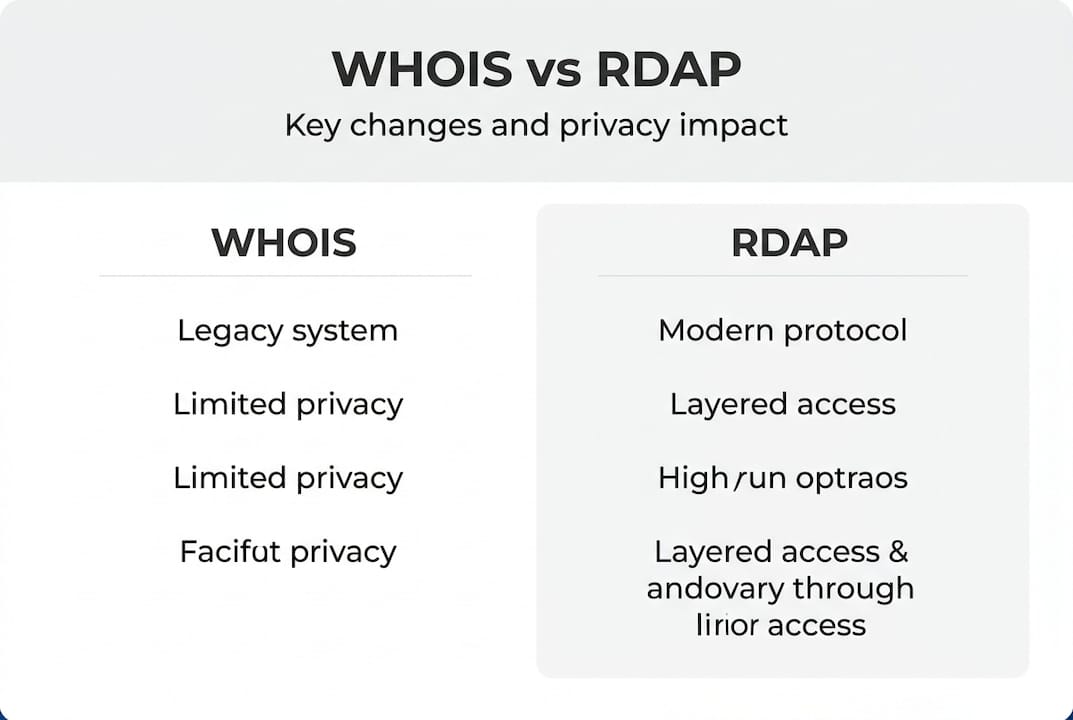
RDAP and its companion system RDRS (Registration Data Request Service) attempt to thread this needle through layered access. Verified researchers, law enforcement, and legitimate security professionals can request fuller records, while the general public sees redacted data. This is a more sophisticated model than the old open-access WHOIS, but it introduces new friction for routine lookups.
The scale of the problem is striking. With 368 million or more domains registered globally, DNS abuse mitigation between September 2024 and March 2025 resolved only 11 to 22 per cent of reported cases within 24 hours, with an average resolution time of eight days. Phishing domains were detected a median of 16 days after registration. That gap represents real risk.
Pro Tip: Before relying on a WHOIS result, check whether the TLD uses a thick or thin model and whether the registrar applies privacy proxies by default. A blank or heavily redacted record does not mean the domain is suspicious. It may simply reflect standard privacy settings. Use reverse DNS lookup to gather complementary network-level data when WHOIS returns limited information.
The uncomfortable truth: WHOIS lookup is not a silver bullet for online security
After years of working with IP and domain intelligence tools, one pattern becomes clear. Practitioners who treat WHOIS as a definitive answer to security or privacy questions are the ones who get caught out. WHOIS is a starting point, not a conclusion.
Attackers adapt quickly. Privacy proxies, fast-flux DNS, and freshly registered throwaway domains all exploit the gaps that WHOIS cannot fill. A redacted WHOIS record tells you something is hidden, but not what or why. A clean WHOIS record does not guarantee legitimacy. Fraudsters register domains with accurate contact details all the time, knowing those details will be abandoned within days.
The practitioners who get the most value from WHOIS are those who layer it with IP geolocation, IP lookup for cybersecurity intelligence, DNS history, and threat intelligence feeds. No single tool answers every question. The shift to RDAP adds structured access and privacy controls, but it also demands that you understand which access tier you qualify for and what that means for your investigation.
The uncomfortable reality is that both transparency and privacy are moving targets. Regulations change, registrar policies evolve, and threat actors continuously probe for new blind spots. Treating WHOIS as a static, reliable oracle is a mistake. Treating it as one valuable signal among many is the correct approach.
Explore advanced lookup tools for deeper insight
Putting this knowledge to work requires the right tools alongside the right mindset. At InstantIPLookup.com, we have built a suite of lookup utilities designed to give you actionable intelligence rather than raw data dumps.
Start with our IP lookup tool to identify geolocation, ISP, and network details for any address you are investigating. If you are concerned about your own privacy exposure, the VPN leak check confirms whether your VPN is actually masking your real IP. For hostname resolution and reverse mapping, the reverse DNS tool rounds out your diagnostic toolkit. Used together, these tools build the layered picture that WHOIS alone cannot provide.
Frequently asked questions
What personal information does WHOIS lookup actually reveal in 2026?
WHOIS typically shows registrant contact details such as name, email, and address, but GDPR redaction and privacy proxies now mask most personal data from public view for European and many other registrations.
Can I use WHOIS to trace the real-world location of any IP address?
No. WHOIS can identify the organisation or ISP associated with an IP block, but end-user IP tracing is limited to ISP-level data and cannot pinpoint a home user’s precise location.
What is the difference between WHOIS and RDAP?
RDAP is the modern, standardised replacement for WHOIS, mandated by ICANN for generic TLDs since January 2025. It delivers structured JSON data over HTTPS with authentication and granular privacy controls, unlike the plain-text WHOIS protocol.
Is WHOIS lookup legal for anyone to use?
Yes, querying WHOIS records is legal and publicly accessible, though data availability may be restricted by regional privacy laws such as GDPR or by individual registrar policies that limit what is returned.
How does WHOIS help fight phishing and online abuse?
WHOIS enables rapid identification of domain registrars and abuse contacts, supporting takedown requests. However, with phishing domains detected a median of 16 days after registration, response speed remains a critical challenge across the industry.

Comments (0)